Showing posts with label Life Skill. Show all posts

Tuesday, 17 March 2015

Why Using Someone's Name Is Important


When I was small, I was very shy and my mum always used to struggle to get me to use peoples names when I said hello or goodbye. Saying "hello" was a push to little-me-at-5-years-old, so saying "hello Eugene" was often unfathomable. Every time I greeted someone, if I just said a quiet "hello", my mum would say "Hello who?" and I would then reply (if she was lucky) "hello Dolores" while clinging onto her leg or hand, looking down to the ground or hiding my face away.

Fast forward 17 years and I found myself sitting in a training session at the Four Seasons in Vail, being taught about the importance of greeting our guests by name and using their name in our interactions with them. I was no longer a 5 year old and I had become much better at greeting people by name (and remembering people's names), but this training session re-emphasised how important it was to use someone's name. It was so engrained in the company culture that not greeting guests by name felt incredibly wrong. Luckily, more often than not, we would at some stage either find out their name when they checked in to their spa appointment or restaurant reservation and you only had to remember someone's name for the duration of their appointment or meal. As a last resort you could get their name off their card at the end of their stay and then say something like "I hope you enjoyed your treatment Mr. So-And-So, I hope we see you again soon".

The idea behind addressing someone by name is very simple. It makes people feel important and valued and that they're a "someone", not a "no-one". If you make people feel important and valued and like a "someone" they're likely to think favourably of you (or your company) and therefore be more likely to want to interact with you (or your company) in the future. It's an easy way to make someone you just met feel important. And everyone wants to feel important. 


~~~~~ Follow Practical Cookie ~~~~~
~ Twitter ~ Facebook ~ Pintrest ~ Instagram ~

Tuesday, 24 June 2014

Oh, The People You'll Meet

I sat in the same row as another engineer on my flights between Joburg and Paris, on my way to and from Italy. And I was reminded that people will always surprise you.

On my way there, I had the most wonderful, interesting conversation with a guy from Zimbabwe, who had studied all over the world and now works in the USA, making aeroplane engines for the A380 aeroplanes (among others). It was wonderful talking to him and we chatted about engineering and the jobs we had been involved in. We chatted about family. We talked about travelling. We discussed Zim and how his views on Zim (as an expat Zimbo). We talked about South Africa. We talked about people, in overseas universities, studying "Africa", without knowing what it's like to actually live here. About our skills shortage in engineers. 

He spoke respectfully and thoughtfully, without giving me the impression that he was trying to be cool or gain one-upmanship. Even when he talked about something that you would perceive to be negative, he did it positively. He engaged both myself and the other guy in our row (who was off to Italy to do training for forklift driving), in conversation and was genuinely interested in what we both had to say. Lastly, he addressed our Air-France hosts and hostesses in their native language! All without show. I have to say, that barely knowing this guy, he has gained my utmost respect.


Sunrise at the airport
Sunrise at Charles de Gaulle Airport on the way to Italy
On my way back, another engineer sat in my row. After the normal, "Hey, howzit going...blah blah" some of the next words out of his mouth were, "Wow, I'm so excited to be going home. This place is filthy and gross. I couldn't speak the language, no one could understand me and I can't wait to get out of here."
Wow, strong sentiments to express to someone who you've only just met and a country that you haven't had time to explore. Although, to be fair, he had been staying in a red-light district and didn't get the note that in France, corporate engineers suit up to go to work and don't really do the whole jeans-and-collared-shirt thing. 

We talked a bit more and I found out he's working for a company that builds trains and he did his thesis in microprocessors and sensors for microprocessing. Interesting job and thesis topic, but after one or two more questions from my side, I gave up making conversation. This guy seemed to be only interested in blowing his own horn or complaining about things. And, to be frank, he was annoying me and all I wanted to do was read my book and then try to get some sleep.  

So, two different flights. Two different chats with fellow engineers who were like chalk and cheese. So much for those boxes and labels that we all automatically put people into when we first meet them (and don't lie to yourself, even if you have an open mind, you make a judgement on people before you even talk to them). 

And I was reminded that people will always surprise you.


~~~~~ Follow Practical Cookie ~~~~~
~ Twitter ~ Facebook ~ Pintrest ~ Instagram ~

Tuesday, 13 May 2014

Energy Out, Energy In

Do you ever get tired of people? Not a specific person, but just people in general? I do. When a few weeks go by and I don't have a chance to be by myself, I start wanting to disappear into the depths of my duvet so that I can process the things I've done and been exposed to. In this way I'm a classic introvert.

I love people. But in order to love them properly, I need my alone time so that when I'm with people I can give them my full attention and interact with them without getting lost in my thoughts.

In physics the world the entire universe, energy cannot be created or destroyed. It just changes state. The total energy that is provided to an object is equal to the amount of energy that can be released by that object. I think the same is true for humans. Some people gain energy from being around people and find that being alone drains them. Others, like me, find that being around people for too long drains them and they gain their energy back by being alone.

I find that the best way to provide myself with energy is to have some quiet time. To loose myself in a book for an afternoon. To chill at home and paint for the day. To bake or cook and loose myself in the activity.The quickest way to deplete my energy stores is to spend every minute of every day with people.

For the last month and a half it's been a non-stop flow of people. While I've enjoyed spending time with them and had a multitude of good times, I noticed that as time went on I started becoming lost in my own thoughts when in a group of people to try and somehow get the space that I had been craving so desperately.

The longer I spend in a non-stop flow of people, the longer the un-interrupted block of time I need to be on my own (or at least doing something where I don't have to interact with someone).

Luckily the busy times have eased up and I'm starting to be able to catch up on my "me time" so that the next time I see friends, I don't zone out or slip away into my own little world...


Moon peeking through leaves
I took this picture of the moon peeking through these leaves
when I was having last minute drinks with some friends one evening.
I love how ethereal it looks - it speak of possibility and imagination and dreams...
What about you? Do you get a kick out of consistently being with people? Or are you someone who needs their space in order to love those around them?

If you click here, you'll find a Ted Talk on introverts that I loved.


~~~~~ Follow Practical Cookie ~~~~~
~ Twitter ~ Facebook ~ Pintrest ~ Instagram ~

Thursday, 27 March 2014

Pink Drive

No makeup selfies are popping up everywhere on facebook. Yesterday morning when logging in to facebook, I saw that I had been nominated by my friend Kate, to take a no makeup selfie and donate money to the pink drive in support of cancer research.


In perusing through the internet, I've found various sources saying different things on the origin of this trend - suffice to say, I don't know exactly where it started but somehow, the #nomakeupselfie is becoming synonymous with donations towards cancer research. 

South Africans wanting to get involved can visit the Pink Drive website to find out more about cancer awareness (specifically breast cancer awareness) in South Africa. The website also tells you about upcoming events in your area. For those in Cape Town, the Pink Drive will be at the Pick 'n Pay Women's Walk in Kenilworth this coming Saturday, 29th March. Gates open at 07:30 am and the walk starts at 09:00 am.

If you haven't been nominated to take a selfie, I would like to nominate you and encourage you to sms the word "pinkdrive" to the number 40158. And here's my proof of donation to the pink drive


Gents, if you're feeling brave, why don't you try out the #manupandmakeup trend by uploading a picture of yourself onto facebook and donating towards the worthy cause of prostate cancer research! Click here and go to their donations page to find their bank details. 


~~~~~ Follow Practical Cookie ~~~~~
~ Twitter ~ Facebook ~ Pintrest ~ Instagram ~

Wednesday, 12 March 2014

What's Your Enough?

I often hear people complaining that they aren't able to afford something. Sometimes they go out and buy it anyway, even if it means living on bread and water for a week/month.

New clothes
Pretty jewelry
Home decorations
A TV
A holiday away
A fancy phone

The list is endless. There's always something that we want, but can't afford. I would like a whole lot of stuff. We go through life accumulating stuff, but just how much stuff do we have to accumulate before it's enough? How much do we need to be truly content. How much is enough?

Enough food so that you go to bed on a full stomach at night.
Enough shelter so that you can hide from the heat and cold.
Enough money to afford your necessary expenses every month.
Enough clothes that you are able to look neat and tidy.
Enough shoes to keep you walking comfortably for days.
Enough stuff that you can live the life you want to live.


What is your definition of enough that will allow you to enjoy the life you want to lead?


~~~~~ Follow Practical Cookie ~~~~~
~ Twitter ~ Facebook ~ Pintrest ~ Instagram ~

Sunday, 12 January 2014

If Diets Worked, We'd All Be Thin Already

I recently posted my views on diets and dieting and this morning when I logged in to my e-mail I found a TED Talk waiting for me and I immediately watched it. It's a 13 minute talk on Why Dieting Doesn't Usually Work by Sandra Aamondt and she gives some scientific insights into why diets don't usually work. She talks about a body's weight set-point, intuitive vs controlled eaters, dieting in children, family members teasing about weight and the benefits of a healthy lifestyle. Take a squiz at the video below.


I am so excited by this video as it sums up my view on food, eating and lifestyle. My "set-point" hasn't changed much since high-school and I think that this is partly because I've always been encouraged to eat when I'm hungry and stop eating when I'm full. 

Near the end of her talk she mentions, "if diets worked, we'd all be thin already. Why do we keep doing the same thing and keep expecting different results. " It's a profound statement and makes you think whether diets are really worth it.

She finishes off by asking us to stay mindful of when we're eating and to learn from your body. She encourages all of us to eat when you're hungry - and stop eating when you're full! Instead of trying to control your stomach through diets, let your stomach control your eating.


~~~~~ Follow Practical Cookie ~~~~~
~ Twitter ~ Facebook ~ Pintrest ~ Instagram ~

Wednesday, 8 January 2014

To Diet Or Not To Diet

"diet" noun

1 the kinds of food that a person, animal or community habitually eats:
a vegetarian diet
            the activities, pastimes, etc. in which a person or group habitually engages:
screen violence is becoming a staple diet of the video generation

2 a special course of food to which a person restricts themselves, either to 
loose weight or for medical reasons


In the last few months I've heard the word "diet" thrown around a lot. 
I was sitting on a plane recently and had 2 ladies sitting next to me who spent almost the entire trip talking about food and dieting. I spent a few days with a new friend who is a dietitian. Family and friends have been talking a lot about food because, well, it was Christmas time and a lot of holidays revolve around food. It's got me thinking about diets and dieting...

Now, for those who know me, I'm probably the last person on earth who should be talking dieting. I've been skinny my whole life and have never been "on a diet". When I was small my folks struggled to get me to just eat what was on my plate and I was well into junior school before the words "I'm hungy" became a regular part of my vocabulary. I haven't ever had to battle with crazy weight fluctuations. I'm incredibly lucky in this regard and am frequently reminded of this from comments (some of them absurd, but I take them as a complement) from friends, family, co-workers and even strangers. 

There are many reasons people go on diets but I think the main two reasons are to loose weight or for health reasons. I don't agree with the concept of "going on a diet" for a week or two. Instead, I believe in changing your diet so that you are able to sustain it over the long term. I also believe in the 80-20 principle, in that if you eat well 80% of the time, it's OK to have that sweet, chocolate or extra-creamy pastry every now and then. I eat when I'm hungry and if it goes for too long, I start getting grumpy (just ask my boyfriend).

So, that's my outlook on diets and dieting in a nutshell. I know there are more complexities to dieting than this, and I'm sure that my opinions on dieting will change as I grow older and my metabolism slows down. However, I hope that in the future, if I need to diet for some or other reason, I will look at trying to change my diet and lifestyle to incorporate the advice given to me, rather than going on a diet for a while and then going back to my old way of eating, only to have the same problem resurface over and over again.


Mulberries


~~~~~ Follow Practical Cookie ~~~~~
~ Twitter ~ Facebook ~ Pintrest ~ Instagram ~

Tuesday, 17 December 2013

Recipe for Awesome (Tiny) Chicken House

This last weekend, I went back to KZN for Frosty's birthday on the farm. We had an awesome dinner and get together with some of his family and friends and he got some awesome presents. But I think the present that will keep him busiest was a chicken called Cheesecake, so named by the lovely gift-giver, Shells. According to one of the guys with us, it's a Black Australorp chicken and Frosty is hoping that it turns out to be a girl so he can have eggs for breakfast every morning, maybe he'll even get a few more so he can invite friends over for breakfast!

Anyway, even though this little chick came in the most beautifully decorated gift box, we decided it needed a bit more room to grow and jump around and thus we decided to build an

Awesome (Tiny) Chicken House

Ingredients

1 x baby chicken (or a few more if you like)


Baby chick with red berries


1 x plastic box (with a lid)


1 x brick with hole in the middle for water

1 x plank of wood, similar in size to your brick


1 x small flower pot


Flower pot


1 x piece of large paper (newspaper works)

a few handfuls of paper cuttings, sawdust, wood shavings or grass

2 x small glass bowls

1 x pen

some water and baby chicked food (we used future life)


Tools

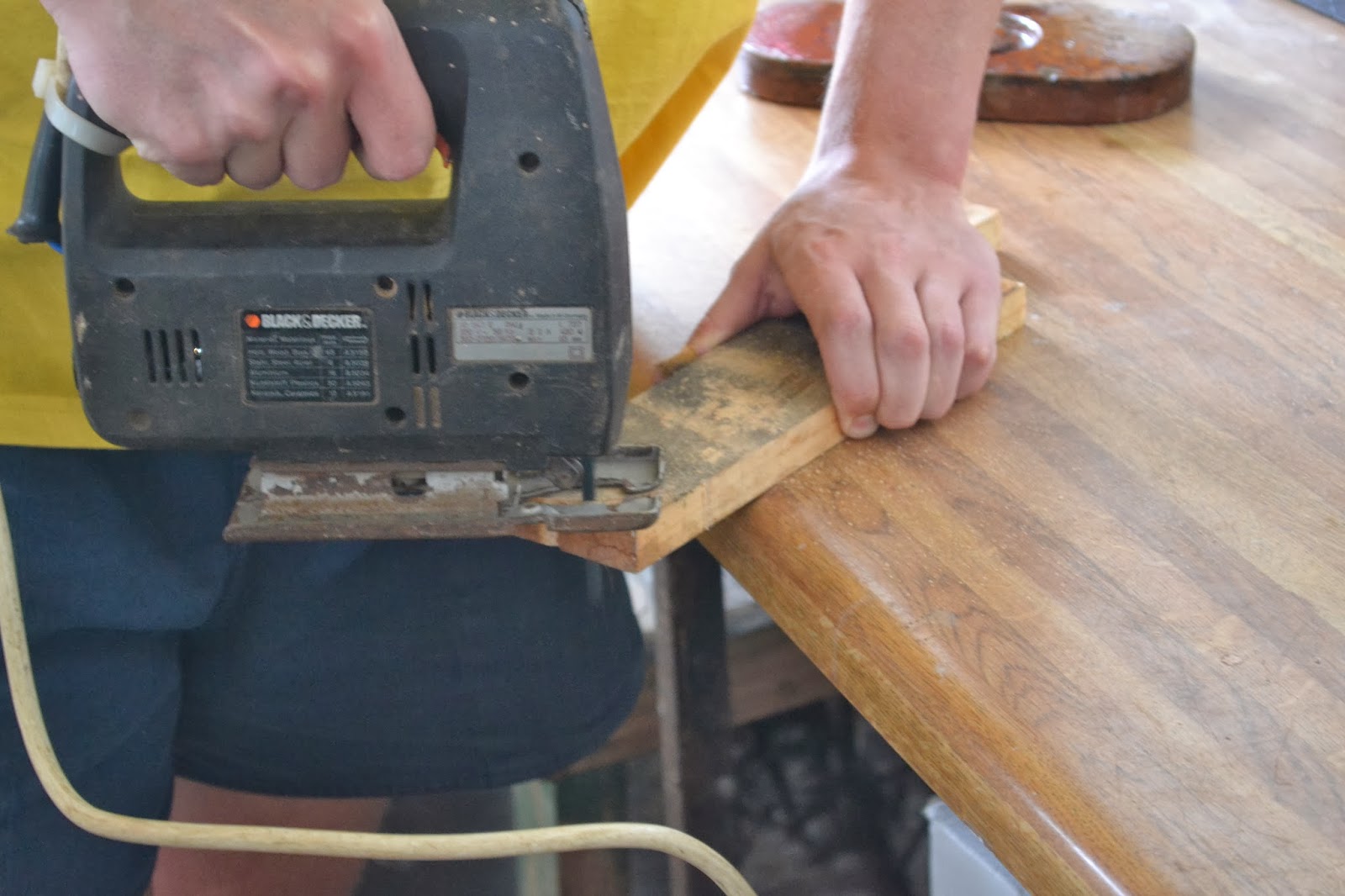
1 x jig saw


1 x hole saw (attaches to your drill)


1 x sander (with sandpaper, you could just use sandpaper as well, it just takes longer)


1 x boyfriend who is willing to show you how to use power tools :)


Method

  1. Wash your box, box lid, flower pot, little glass bowls and brick (just a rinse to clean off any dirt that may have accumulated while they were sitting in the garden, gathering dust). Leave them to dry.
  2. Put the wood plank over the brick and mark out where you'll be cutting it.
  3. Take the jig-saw and cut where you marked out.

  4. Take the hole saw and drill away two holes - make sure that your 2 glass bowls will fit into the holes you've drilled! (You can use the cores to make cool Christmas decorations!)

  5. Use the sander to sand away all the splinters on your feed holder.
  6. Put everything into the box as illustrated below and voila - your new Awesome (Tiny) Chicken House!


I've decided that I quite enjoy using power tools (even though I'm an engineer, most of the power tool stuff is done by my artisans) and so if anyone has any suggestions for other cool projects involving power tools, send them through!

* We weren't using any safety gear here - ideally you should wear goggles and ensure all your pieces you're working with are secured with clamps to minimise risk of injury!


~~~~~ Follow Practical Cookie ~~~~~
~ Twitter ~ Facebook ~ Pintrest ~ Instagram ~

Saturday, 9 November 2013

What's Your Closet?

Have you ever watched TED Talks? They're short 5 - 20 minute talks given by people on every single topic under the sun. Some of them are scientific. Some are funny. Some display skills that blow your mind and some relate advice for living life and being awesome. They generally leave you inspired and mind-blown! Yesterday I watched one given by Ash Beckham, take a look at it here.

If you're too lazy or don't have a good enough internet connection (the joys of living in Africa) here's a summary:

Ash compares all difficult conversations or situations to coming out the closet. She knows about these difficult conversations, as she literally had to have her own difficult conversation when she admitted to her family and friends that she was gay. She urges people to stop ranking their difficult conversations, trying to out-do each other in "hardness". Difficult conversations are hard, full stop. She recognises that whatever closet you come out of, you will be challenged and you will need to take a dose of courage to do it. She encourages us to sympathise with others, instead of judging them as every single person has their own closet to come out of. 

She shares some awesome bits of advice, that all came to her after an interaction with a little girl at the diner that she worked at. This little girl asked her whether she was a boy or a girl and even though she was ready to go all hardcore lesbian on this tiny little girl, she instead gave her the answer that she was more of a comfy pj's girl than a pink dresses girl. The little girl responds by describing her own pj's and then asking for her pancakes. Easiest hard conversation ever.

And the advice she gives when you have to have a hard conversation of your own?

1. Be Authentic
2. Be Direct
3. Be Unapologetic

I think it's definitely advice we can all relate to. She finishes off by encouraging people to never apologise for being true to yourself. Any expectations that others have of you, are ultimately their expectations of you. And if the reality does not live up to their expectations then they need to manage their expectations of you, as long as your expectations of yourself allow you to stay true to who you are. 

When having difficult conversations of my own, I've found that the easiest difficult conversations have always been ones in which I've followed the advice above (or when others have followed that advice with me). Be sensitive to the way that you convey your information, but don't pussy-foot around something so that by the end of the conversation you don't actually know what the point was - you'll just have to have that conversation all over again.


~~~~~ Follow Practical Cookie ~~~~~
~ Twitter ~ Facebook ~ Pintrest ~ Instagram ~

Flourless Chocolate Lovers Treat

Chocolate. Yum. I was given a Woman&Home, Pick 'n Pay recipe booklet by a friend a few weeks ago. Last weekend I decided to test out this awesome recipe for a "chocolate soufflé" type dessert since Frosty was around and we were too busy to bake brownies to send back to Cape Town with him. 

Ingredients

60 g 70% dark chocolate
50 g butter or marge (guess which one I used)
2 large eggs, separated
50 g white sugar

Chocolate on top of egg yolk-sugar mix on top of whipped egg whites - ready for a final mix
before going in to the mugs.


Method
  1. Pre-heat over to 200 degrees C and lightly grease your moulds.
    (I used my awesome striped coffee mugs without greasing them, and they were fine - I did put them in my baking tray though, to contain any spillage)
  2. Melt the chocolate with the butter/marge and leave to cool. (I did this by putting a small pan on the stove, with some water in it that was on a medium heat. Then I got a glass bowl, put it over/into the pot and put my marge and chocolate in the glass bowl to melt it)
  3. Mix the egg yolks with the sugar until light and creamy. Whip the egg whites until firm.
  4. In another mixing bowl, combine and gently fold all the mixtures together, spoon them into your moulds (or coffee mugs) and bake them for 10 minutes.
Flour-less chocolate pudding
The final product - the centre is soft and gooey and the outside is warm and cake-like!


~~~~~ Follow Practical Cookie ~~~~~
~ Twitter ~ Facebook ~ Pintrest ~ Instagram ~

Monday, 21 October 2013

Grad Learnings

Last year I was part of a graduate program with my company. It introduced us to the complexity of supply chain and also aimed to give us broader business exposure. This year I have been part of the organising committee for the current grads and it's been an awesome experience. Last week we held our last grad event for the year.

At 4:30 last Tuesday morning I dragged myself out of bed so that I could get started with lifts to the airport for two of my grad friends. When we got there the whole of OR Tambo carousel had broken down and everyone's bags were piling up at the check in counters. I felt sorry for the poor guys who had to fix that broken carousel - they would have been feeling the pressure even more than our guys do when one of our conveyors breaks down!

Anyway, we got to Durban in one piece. I would really like to give credit to ACSA and all the airlines - even though our bags didn't come with us on the plane, our details were noted down and they were delivered to our hotel later that morning.


For the first day, our grads had the morning to finalise their business case presentations that they had been working on for the last month or so. We then went to another venue where they presented solutions to current issues in our company to members from the senior leadership team. They did a lot better than our group last year - we were told to go back, re-think our presentations and do them again in two weeks. This year they were much better prepared - mainly due to the horror stories and threats that they had been told by myself and the other committee members. 

There were very good questions asked by the leadership team at the presentation. The learning that I took away with me this time was to take a look at how leaders can remove complexity from their business. How can you use current tools (or remove tools completely) in order to make your teams lives easier? Perhaps all the tools are there and it's the behaviour that isn't proper. How then can you change behaviour to make the best use of the tools that you have?

On the second day, we visited one of our packaging suppliers and it was awesome to see incredibly different technology at work in their factory. We learnt a bit about the difficulties experienced from their side of the business and of potential areas of improvement between both parties. That afternoon we took the grads back to head office where they were split into teams to do a negotiation role play between a supplier and customer. As most of our grads are engineers and had no clue about how to go about a negotiation, there was a huge amount that all of us (committee members included) learnt from participating and observing the negotiation prac.


What I took away from the prac is that maintaining the relationship and respect for the other party is incredibly important. It's also important to prepare - it was suggested to us that for every hour spent negotiating, you should prepare for 9 hours! You need to be willing to compromise on some things in order to gain advantages somewhere else. You also need to be strategic on the points that you negotiate on - it's very difficult to negotiate on labour and fixed costs. Rather pick things where for a seemingly insignificant decrease/increase you get a larger reward.

That night the committee had a close off event. All I'll say it that it was amazing. And all of us may or may not have felt tender for the whole of the next day...

We had a fear factor food race- split into 3 teams
and 3 different foods - I got the chicken feet as my dish...
Luckily there was some traditional Zulu beer to act as a
chaser afterwards! 
On the last day we had a visit to a factory that manufactures specific types of parts for the motor industry and it gave us a chance to see a different type of manufacturing and supply chain process. To end off the day we had a close off lunch with everyone, got feedback on the program and we gave out a few awards. We got such positive feedback from the grads this year and I hope that next year it's even better for them!

And to my fellow committee members - it's been such a pleasure and I'm going to miss all of you and my excuse to come and visit Durbs next year!

Grads bonding over a drumming session at the
close off event while committee wrapped up award nominations


~~~~~ Follow Practical Cookie ~~~~~
~ Twitter ~ Facebook ~ Pintrest ~ Instagram ~

Tuesday, 15 October 2013

Post-Its and Papered Walls

I completed a 3 day planning workshop for a major, complex project we're about to launch at our factory. Wow. By the time we had finished, the pristine white sheets of paper that we had stuck over the walls and windows of our room had become littered with coloured post-it notes and kokie lines. I now view post it notes, markers and white sheets of paper stuck on walls in a whole new light.

I know a lot of people (especially a few of my girl friends) love to use post-its to place in their diaries, on their fridges and as quick thank you notes to friends. I've come to see this as a conventional use of post-its. 

This week, myself and the guys (yes, all the rest of the team were guys) spent time classifying and writing big tasks on post-its, then breaking up the big tasks into smaller tasks and writing them on post-its. Then breaking those tasks into smaller tasks on post-its. Each post-it had the task, name of person responsible, company, estimated duration and set of 3 or 4 filter "tags" written on it.

Hard at work writing post it notes
Then all the post-its were ordered according to logical sequences and processes and a temporary pencil line was added in to show the link between tasks. Each post it and all the accompanying information was then captured on to the computer as part of a database. During capturing, each note was given a corresponding number (according to the database number on the computer) and a red dot, to indicate it had been captured on the computer. Notes with a blue dot were used to indicate a delivery of something. Then processes were linked, and during this time, a blue line was drawn indicating links between the different tasks. By the end of our 3 day period, we had something looking like the below image and an ultra complicated project breakdown.


Discussing process and logic sequences

Part of our final project plan according to post-its

I've never been part of a big project planning session and this was an extremely enlightening exposure to an amazing project planning technique and tool. For the new people (like myself), our facilitator's aim was to ensure that we understood the project planning process so that going forward, we can facilitate other project planning sessions. I'm sure that I will be able to use this tool going forward, as it's applicable to all projects, not only engineering ones. However, this is only the beginning and our facilitator will have regular check-in sessions with us to track our progress and I'm sure there's still a lot to learn from him about the project planning process.


~~~~~ Follow Practical Cookie ~~~~~
~ Twitter ~ Facebook ~ Pintrest ~ Instagram ~

Saturday, 28 September 2013

Interview Types and Tips

Interviews. For anyone looking to be employed by someone else, you will have to go to interviews. My boyfriend is currently going through this whole interview process so I thought I would use the opportunity to share with you what I learnt. During my final undergrad year I went to lots of interviews, so here are some types of interviews you can expect:
  • Assessments - you will have to complete a variety of "tests" and they're usually done by the bigger companies, although some smaller companies may do them too. They test things from how quickly you learn to hardcore technical skills to what type of person you are. Often the tests are annoying. But when I got offered my current job, a complete stranger summed me up in a few sentences which was pretty astounding - so don't assume the tests are irrelevant. They could make or break your chances of getting a further interview
  • Group sessions - in this type of interview you will be put in a room with a bunch of other hopeful applicants and given a case study. Often you are expected to play a certain role and solve a problem. Don't be fooled - it's not about coming up with a peaceful solution to the problem. The assessors want to see how you interact with other people and what sense of business you have and if you're able to look at an issue from a variety of angles. Again, these are usually done when being interviewed by a larger company.
  • Role play sessions - very similar to the group sessions, but this is where you are given a role and told to role play with employees at the company. They will give you a certain situation/case and you may or may not be given time to come up with a game plan before you start to role play.
  • Face to fact interviews - this is where you will generally meet with an HR rep and/or other employees of the company. These are probably the most difficult interviews to prepare for because you can get asked anything. At one interview for a large clothing company, I was asked about their financial report for the year. I didn't get that job. But most face to face interviews are a time to get to know you, they may ask one or two simple technical questions to assess your basic knowledge, they'll want to know your plans for the future. They will probably ask you to tell them a bit about yourself - don't tell them boring things, tell them things that will cause them to remember you.
I've been interviewed and I've also interviewed others and found it really interesting. Here are some other tips I've picked up in the process, or been given by family and friends:

  • If there's no dress code specified on the interview invitation, ALWAYS be smarter than you think you need to be. Even if they give a dress-code, it's always better to look smart, or dress slightly smarter than the dress code stipulates. A scruffy dresser will give a bad impression before you've even opened up your mouth. A professional looking outfit will give people the impression that you're capable and willing to make an effort.

Who would you hire?
An unprofessional imageA professional image

  • Don't mumble or give one word answers. It's difficult to get an impression of someone when you can't understand them or they don't elaborate on a question.
  • Have an idea of a few long term goals that you want to achieve and where you want to be a few years down the line. You may want to live close to your family. You may dream of travelling for 6 months after 5 years of work. Maybe you want to be a manager within x number of years. My long term goals are to pay off my loans and to eventually pursue a masters in biomedical engineering.
  • Who are you? You need to be able to tell the interviewers a bit about yourself. Who is Cath? If you say electrical engineer and stop talking you're not going to get very far. Tell people who you are. What makes you tick? What makes you happy? What makes you annoyed.
    I am an assistant engineer with a year and a half of experience in the maintenance department. I enjoy programming. I enjoy time to myself but I also love to be around my friends and family. I don't give up easily when faced with a challenge. Stupid people really annoy me. In my spare time I enjoy to paint and take pictures. I love seeing what South Africa and the rest of the world has to offer. I work hard, but when I'm not working, I don't want to think about work. Which "Cath" is more interesting to you?
  • Try to give as many real life examples as possible. If you're a graduate, you probably don't have work examples to give. Give examples from varsity or your personal life. Have examples ready for the following types of questions: how do you deal with difficult people? What happens when you don't want to get up in the morning? When did you have to take the lead? What do you do when you try to negotiate something with someone and they won't budge? Give an example of a time you have succeeded and what do you think went right? Give an example of a time you have failed or done something wrong and how did you deal with it?
  • Connect with your interviewers. They're people too and they're looking for people that they like and that will fit in to the current team.
  • Don't EVER tell the interviewer what you think they want to hear. They can smell a phoney answer from a mile away; it sounds incredibly insincere and will probably turn them off you in a heartbeat. Instead, try to structure an answer that you can both work with. Where do you see yourself in 5 years time? If you answer "Working for this company because it's the greatest company ever", you'll probably shoot yourself in the foot. Tell them that you want to be in a management position. If they're an international company, maybe you want to be in a position that allows you to travel a lot. If they're a smaller company, you might want to mention that you're interested in specialising in hardware design and they're a good company to learn hardware design from. There are no right answers. But a sincere answer will go a lot further than a fake answer.
  • Honesty is the best policy. In all my interviews I've been incredibly honest. While I was interviewing I was also planning a trip to the USA for 4 months with Frosty and some friends. I told every interviewer of this up front. I got solid offers from 2 big companies within a day of each other. If they want you, they'll be willing to wait.
  • Treat your interview experience as a chance to chat with people and practice your interview skills. Learn from each interview so that at the next one you can be better prepared. This is your chance to interview the company as well. If, after the interview, you think you wouldn't be a good fit, tell them upfront to disregard you from the rest of the hiring process.
  • Be on time. Your interviewers may be running late. But you must ensure that you're on time to your interview. Take a book to read with you in case there are delays.
  • Think up a few questions beforehand that you can ask the people interviewing you. These questions may get answered during the interview, which is fine. But it's always good to write those questions down and consult them at then end of the interview to make sure everything you want to know is covered as well.
I'm not a professional interviewer and these techniques may not work for everyone. You may get asked a completely different set of questions to the ones listed here. I'm just sharing what I've learnt, the types of questions I've been asked and a few tips from personal experience in the hope that it will help you be prepared for future interviews. If you have examples of other interesting interview questions, please leave them in the comments box below!


~~~~~ Follow Practical Cookie ~~~~~
~ Twitter ~ Facebook ~ Pintrest ~ Instagram ~

Wednesday, 18 September 2013

Learnings Of A Generation Y New Employee

We live in an age of instant gratification. I recently read a post about why generation Y yuppies are unhappy and it gave me some food for thought. Before reading the rest of my post, you can check out the generation Y post here.

Clouds over mountain with statue and dam in the foreground
Metaphor for what I thought my job would look like
before I started working...

When the post talked about generation Y kids starting out in their careers and expecting them to be great from day 1, I instantly related to this. I've been working for just over a year and a half and it's only in the past few months that I've really begun to feel a sense of making a difference in my job. My parents, grandparents and other older relatives and family friends all told me that it was going to take time and that no matter what job I start out with, it's likely to be crap. So, even though I logically knew that my first 6 months to a year were going to be tough, it was still frustrating to me when they were even tougher than expected. 


Desolate landscape
...Metaphor for what my job actually looked like
a few weeks after I started

I also got given some really amazing advice from the older people in my life that I took to heart. Using this advice helped me to make the most of a bad situation, here are some of the things I've been told about or learnt along the way that pertain to my experience as a new employee:


  1. Be humble. When you go into a job as a newbie, expect to know nothing. Instead of acting like you know it all (and even if you think you know how to do something or how something works) rather ask. No one like a know it all. But when the "know-it-all" knows nothing about the company it's even worse (and you end up looking really stupid, instead of intelligent).
  2. Give it 6 months before you decide on whether you like the job or not. It takes a while to learn the ropes and how a company operates. Add to this trying to learn how to be useful to your company - the only way to settle into your new job is to give it time.
  3. Be willing to learn. Ask questions. Don't assume that just because someone is a cleaner, tea-lady, receptionist that you can't learn from them. I've learnt the most interesting things from some extremely surprising sources. Our engineering finance lady knows more about machine inspections and care than I did when I first arrived - and she doesn't have a technical degree, just years of factory experience.
  4. Find the gap and fill it. When I arrived our control systems were buggy and no one was really looking after them. I've now become the "go to girl" for control systems in our factory. No one asked me to do it. I saw the gap and took it. The fact that I have my own set of "go to guys" (who have years more experience than I do) is irrelevant. What's important is that I'm driving change with control systems where before there was none and that is what makes me valuable to my team.
  5. Observe the good and bad managers. Knowing how to interact with people is extremely important. So is knowing how to handle and motivate a team. Taking note of how managers interact with people and deal with their teams is an important part of growing in business. There are techniques that you will learn from the good managers and there are techniques you'll learn to avoid from the bad managers.
  6. Chat to the people in your company who have been there for years. The quiet, white haired grandfather figure who keeps to himself and gets on with the job is only too happy to help out, no matter what problem you face. The talkative co-ordinator who is always reminiscing about how things used to be done in "the old days" has held a variety of positions within the same factory and understands the subtle people interactions you need in order to keep things running smoothly. And the blunt, no bull artisan who kaks guys out when they're not pulling their weight has a heart of gold and knows exactly how to coax another day's work out of something that should have broken down a month ago.
I've applied all of these things to my job and even though it hasn't been rainbows and unicorns, I can appreciate that there's a lot in life that needs a long term approach and building a career is one of them.

Since I'm a generation Y kid, I'll always get a kick out of instant gratification. However for the big things in life, I'm trying to look past instant gratification (no weekly clothes shopping trips for me) and rather invest in building a life, career and name for myself that will reap rewards years down the line. Starting now. And maybe, if I'm lucky, my current investments will start to reap rewards sooner than expected and I'll get not instant gratification, but delayed, prolonged gratification.


~~~~~ Follow Practical Cookie ~~~~~
~ Twitter ~ Facebook ~ Pintrest ~ Instagram ~

Saturday, 14 September 2013

Homeowner 101

When I was at varsity I read a few of the books from the Rich Dad and Rich Women series by husband and wife duo - Robert and Kim Kiyosaki. The two most inspiring books were "Rich Dad, Poor Dad" by Robert and "Rich Woman" by Kim. To learn more about their books and products, you can click here to go to their website. Since then, the idea of buying up property to create cashflow has been ingrained on my mind and I decided that I would buy my own property as soon as it was feasible. 

A while ago, the opportunity came up for me to buy the flat that I have been renting for the past year or so. I hadn't been planning on buying property so soon after starting work so I thought long and hard about the decision, crunched my numbers and decided it would make a good investment. Even though things will be tight for a while, I've taken the plunge and I'm really excited about my decision. I've bought the flat with the idea that I will be renting it out in years to come, when I move out. There was lots that I have learnt through this whole property buying process. You can find some of the key points below, along with the costs that you don't really think to take into account:


  1. You decide at some point that you want to buy property. I was lucky and the opportunity presented itself to me. For other properties I will probably need to search a bit harder. Shop around before deciding on the property - you need to be sure it's the right one for you.
  2. You crunch your numbers and if you can afford it, make an offer on the house. If the seller likes your offer, they'll accept. Otherwise they'll decline and you can make a higher offer or find something else.
  3. You then go to the bank to see if they will loan you the amount you need. For first time buyers you will usually be awarded the full amount of the loan you request. For more experienced buyers they will probably award you less than the full amount and you will have to come up with a portion of the money yourself. You can approach banks yourself about the loan. Or you can get someone called a "bond originator" to do it for you. I got my loan through a bond originator. You don't pay fees to them as (I think) they are paid by the bank. Your estate agent should be able to recommend someone to you.
  4. Your bond (hopefully) gets approved. Then you start getting lawyers involved to help you file paperwork etc etc. This part is quite hazy to me. Usually the seller nominates a lawyer to help with the transfer. Luckily for me my dad is a lawyer and the sellers, at my request, agreed to use him to do the transfer (and thus I was able to save on some lawyer fees there, but apparently they would have been about R10 000).
  5. As this was my first property, I needed to get life insurance organised. Banks do offer up their own life insurance, however, I found my own life insurance privately for about half the monthly amount that the bank was offering me, R140 per month as opposed to R300 per month.
  6. I also dealt with another set of lawyers - I stand to be corrected, but I think they represent the bank - who facilitated the signing of the contract for the loan from bank to me. I had to pay them about R10 000 for the work that they did. I also had to make up front payments for 3 months worth of my rates and levies which came to about R 2000.
  7. After that, there was quite a wait for the papers to be transferred into my name, but finally they all came through. My dad got help from a lawyer in Joburg for this and he also waived his fees, which would have been about R 1700. The bank then contacted me to confirm the date of my first loan repayment, which is near the end of this month. 
All in all, not including my monthly life insurance payment, my fees should have come to R23 700, I was lucky to get away with paying only half of this. However, when you're thinking of buying your first property, I would say try to find out what you'll need to pay in lawyers fees as well. And if you can't find out, use the number above as a guideline (and maybe add a few extra grand, just to be safe).

Now, I'm sure I've left out a whole bunch of details that are important, but it's a long process and these are the things that jumped out at me as being important milestones in the process. The best way to learn is to do. Even though it's scary and huge amounts of money, I think of it as "forced savings" - once I've paid off my flat I'll have effectively "saved" money up to the value of my flat. And if I don't sell my flat, once I've paid it off, any rental income that I get from it, will be mine to use as I like (probably to go out and buy another rental property!).


Snow in Benoni
It snowed last year around about this time!
The door to my flat is at the top, right in the middle.
Ghost wine glass image
Playing with my camera and a wine glass on the walkway/ledge
outside my flat.


~~~~~ Follow Practical Cookie ~~~~~
~ Twitter ~ Facebook ~ Pintrest ~ Instagram ~

Monday, 2 September 2013

Breaking Point

Lightning in grey sky

How do you know when you've reached breaking point? That time when enough is enough. When cracks start to show through your smile. When you can feel your resolve and determination crumble and all you want to do is run away and let someone else deal with the issues that have to be dealt with. Sometimes it's obvious. Sometimes is sneaks up on you. Either way, you start to wonder if what you're doing is actually making a difference, and if it is making a difference, why aren't you seeing it?

Black dog running along forest path

It's different for everyone - I become an emotional wreck. I cry. A lot. I battle to stop crying, even when friends and colleagues try to distract me with coffee, hugs and funny stories. This weekend I reached breaking point (it snuck up on me) and this morning it showed.

I went in to chat with my boss as soon as he got in and asked him for some time off because I've reached my breaking point. It's got to the point where I start to freak when I hear my phone whistle to tell me a message has come through and I panic when I hear my phone ring. I know that he's under even more stress than I am but he still took time to listen to me and sympathise with me. He's given me words of encouragement and called me up this evening to check up on me, with the first words out of his mouth being "don't worry, it's not a call out". I asked for tomorrow off as a sick day as well and he's given me that. 


Maintenance/Engineering Team May 2013
One of the artisans in my team sent me a message after I left the office today saying that he was worried because I looked so sad and that I must enjoy my time off, rest and chill out. It may have brought a few tears to my eyes but it also made me realise that even though I'm extremely different from most of my team members (I'm wearing the black and grey striped jersey in the pic above), they still value and respect me as one of them.

Another colleague/friend saw I was a wreck this morning when he came to see me with a change request, so he left my office, but soon after sent me a message saying that he's happy to have coffee and just chat if I need to. I took him up on the offer just before I left today and it definitely helped to just shoot the breeze for a while and take a break.

I've also been given lots of advice from one of our software contractors who has been in a similar position to me: take some time off and if I need to get medication for stress, do it. It's a job and my health and well-being is more important than getting stressed beyond what I can handle. Just before I left, he and his office mate went on to distract me with advice on good movies to see and the driving habits of Pretoria/rest of South Africa vs Joburg drivers.

All of the people I've chatted with today have been males and they've listened to what I've had to say and given me words of encouragement, letting me know it's alright to take some time off so I can get my head back in the game. And if I shed a few tears along they way, they were OK with that too. Even though the work is tough and frustrating, there are pockets of awesome people, like the guys today. Whoever said engineers and technical people aren't in touch with emotions obviously haven't met these guys!

So, what do you do to come back from your breaking point? Some people resort to therapy - talking therapy, walking therapy, eating therapy. I'll do those tomorrow. Today I resorted to reading and retail therapy :)


~~~~~ Follow Practical Cookie ~~~~~
~ Twitter ~ Facebook ~ Pintrest ~ Instagram ~